
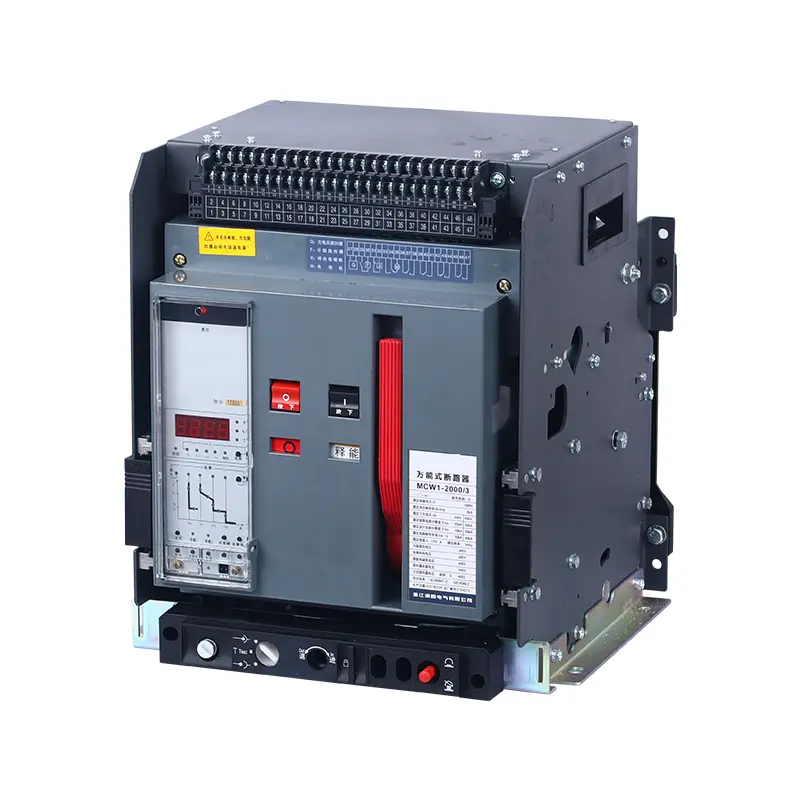
When I’m dealing with main incomers, bus couplers, generator tie-ins, or large feeders, I need protection that can do two things well: interrupt severe faults safely and still stay predictable under changing loads. In those roles, an Air Circuit Breaker is often chosen because it’s built for higher current ranges and a stronger interruption capability than small breakers, while offering protection settings that can be tuned to match coordination requirements.
| What I check | Why it matters to me | What a good answer sounds like |
|---|---|---|
| Rated current range | Confirms whether the breaker family can cover current needs now and later | Options that scale across large LV distribution currents, not just one rating |
| Poles and system fit | Helps match the grounding scheme and distribution architecture | 3P/4P options that match how the site is wired |
| Short-circuit breaking capability | Defines how confidently it can interrupt severe faults at the installation point | Clear breaking capacity range and application guidance |
| Protection adjustability | Supports coordination and reduces nuisance trips | Adjustable long-time/short-time/instantaneous logic or electronic protection options |
| Installation and maintenance style | Impacts downtime and how quickly technicians can work | Fixed or draw-out style based on service needs and switchboard design |
| Standard alignment | Supports procurement acceptance and consistent performance expectations | IEC-aligned design approach with documentation that procurement can verify |
In my experience, the best return shows up where the load is expensive, the downtime is costly, or the fault level is high. Common examples include:
This is one of those choices that looks like “hardware preference” but behaves like an operations decision. I usually decide based on maintenance pressure and site uptime requirements.
At purchasing time, I care about more than a product listing. I want a supplier that can support selection decisions, avoid misapplication, and keep communication clean during procurement. What I appreciate is when the product line is organized around real project ranges (current ratings, poles, breaking capacity options) and the support team can talk through use cases instead of just repeating marketing lines.
When a supplier can help me match the right Air Circuit Breaker configuration to the site’s fault level, coordination needs, and maintenance plan, it reduces commissioning surprises and lowers lifecycle cost. That’s the kind of “advantage” that matters long after the shipment arrives.